Book Categories:
Wait, don't go!
We have a special offer just for you!
Get 20% off your next purchase.

Book Categories:


We have a special offer just for you!
Get 20% off your next purchase.


Collecting rare books often begins with a simple feeling: admiration. A book may attract you because of its age, its binding, its illustrations, the name on its title page, or the sense that it carries a fragment of another era. Yet for a beginner, the world of rare books can also seem opaque. Prices vary widely, terminology is unfamiliar, and the difference between an attractive old book and a genuinely collectible copy is not always obvious. The good news is that rare book collecting does not require enormous wealth or formal training. It requires curiosity, patience, and a willingness to learn.
The first and most important step is to define what you want to collect. New collectors often make the mistake of buying whatever appears old or impressive. Age alone, however, does not make a book rare or desirable. A more intelligent approach is to focus on a clear field of interest. That field may be an author, a historical period, a subject, a language, a region, a genre, or even a type of book production such as illustrated editions or fine bindings. A focused collection develops character over time and helps you make more disciplined decisions.
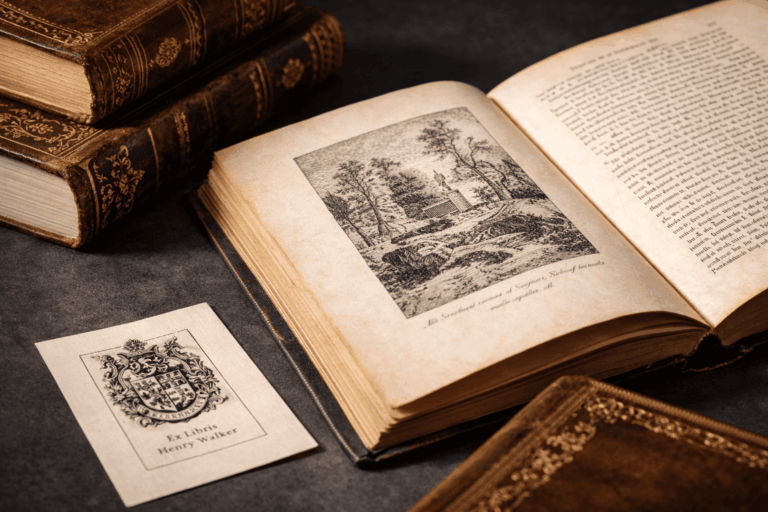
Once you know your area of interest, learn the basic vocabulary of the trade. Terms such as first edition, limited edition, signed copy, provenance, foxing, collation, dust jacket, and binding are essential. Understanding them will help you read descriptions accurately and judge whether a book is priced fairly. A first edition is often more desirable than a later printing, but not in every case. Provenance, meaning the ownership history of a book, can also add interest and value, especially if a copy belonged to a notable individual or institution. Condition, meanwhile, matters greatly. In rare books, even small defects can affect desirability.
For beginners, condition should be studied early and taken seriously. A book may be rare, but if it is badly damaged, incomplete, heavily repaired, or poorly stored, it may not be a wise purchase. Pay attention to missing pages, detached boards, staining, annotations, wormholes, loose bindings, and signs of restoration. At the same time, do not expect perfection in very old books. A nineteenth-century or eighteenth-century volume will naturally show age. The question is whether the wear is acceptable, honest, and consistent with its age, or whether the copy has suffered serious loss.
Another sensible principle is to begin modestly. You do not need to start with highly expensive first editions or museum-grade copies. In fact, it is usually better not to. Early purchases should function partly as education. Buy books that are interesting, well-described, and within a comfortable budget. Study them in hand. Examine the paper, typography, bindings, and signs of use. Compare copies across dealers and auction records when possible. Over time, your eye will improve. Good collectors are trained not by theory alone, but by repeated contact with real objects.
It is also important to buy from trustworthy sources. Reputable booksellers provide accurate descriptions, disclose defects, and answer questions clearly. They are not merely sellers; they are guides in a complex field. For a beginner, a reliable dealer is often more valuable than a low price from an unknown source. When buying online, ask for additional photographs if necessary, especially of the title page, binding, spine, and any notable damage. If a description is vague, that is a warning sign. Precision usually reflects professionalism.
One of the most common beginner mistakes is collecting without a plan. Another is buying solely because a book seems cheap. A low price does not automatically mean good value. A book that does not fit your collection, has weak condition, or lacks bibliographic importance may remain a poor purchase even at a discount. A third mistake is overestimating rarity. Many old books survive in large numbers, while some relatively modern editions are much scarcer. Rarity must be understood in relation to supply, demand, and collector interest.
Documentation is another habit worth developing early. Keep records of what you buy, when you bought it, from whom, and in what condition. Save invoices and descriptions. This is useful not only for insurance or future resale, but also for the intellectual coherence of your collection. A well-documented collection has greater integrity than a random accumulation of objects.
Finally, remember that the best collections are built gradually. Rare book collecting is not a race to acquire expensive items. It is the slow formation of judgment. A meaningful collection reflects taste, knowledge, and continuity. Begin with what genuinely interests you, buy carefully, study every purchase, and allow your standards to sharpen over time. If you do that, you will not merely own old books. You will build a collection with identity, substance, and lasting cultural value.