Book Categories:
Wait, don't go!
We have a special offer just for you!
Get 20% off your next purchase.

Book Categories:


We have a special offer just for you!
Get 20% off your next purchase.


In the world of rare books and art, collectors often focus first on visible qualities: age, condition, rarity, authorship, or beauty. These are essential factors, but they do not tell the whole story. A book or artwork is not only an object; it is also something that has moved through time, passed through hands, belonged to places, and accumulated traces of ownership. This history of possession is known as provenance. For serious collectors, provenance is not a decorative detail. It is a form of evidence, a source of meaning, and in many cases a major component of value.
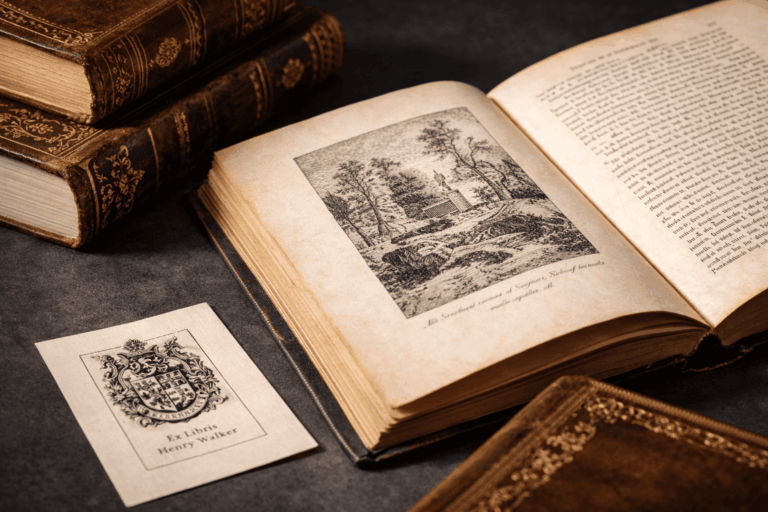
At its most basic level, provenance refers to the documented history of an object’s ownership, custody, or location. In rare books, provenance may appear in bookplates, inscriptions, signatures, shelf marks, library stamps, auction labels, bindings associated with a particular collection, or archival documentation. In art, provenance often takes the form of gallery records, exhibition history, collector inventories, estate papers, invoices, and catalog references. In both fields, provenance provides continuity between the present object and its past life. It answers a crucial question: where has this object been, and in whose world did it once belong?
This question matters for several reasons. The first is authenticity. Provenance can help confirm that an object is what it claims to be. A rare book with a traceable history in respected collections is easier to trust than a similar copy with no documented background. Likewise, a work of art supported by a strong chain of ownership and exhibition record carries more credibility than one that appears on the market without context. Provenance does not prove authenticity by itself, but it strengthens the evidentiary framework within which authenticity is judged. In markets where forgery, misattribution, and alteration are real risks, this function is fundamental.
The second reason is historical meaning. Provenance transforms an object from a static artifact into a participant in cultural life. A book that once belonged to a noted scholar, writer, aristocratic library, or important institution carries a different intellectual weight from an otherwise identical copy without such association. A painting that hung in a significant private collection or appeared in a landmark exhibition acquires an added layer of historical presence. Provenance reveals that objects do not merely survive history; they move through it. They are handled, exchanged, inherited, gifted, annotated, displayed, and interpreted across generations.
For collectors, this added historical dimension can be deeply compelling. A signed inscription from one author to another, a marginal note by an early reader, or a bookplate from a distinguished library can make a copy not only rarer, but more individual. In such cases, provenance contributes something that edition, condition, and scarcity alone cannot provide: narrative. It gives the object a biography. And in collecting, biography matters because it connects ownership to culture, intellect, and memory. A book with provenance is not merely a copy of a text. It is a witness to the lives through which that text passed.
Provenance also affects market value, sometimes substantially. In rare books, association copies and distinguished provenances can command large premiums. A first edition is valuable, but a first edition inscribed by the author to a major contemporary figure may be far more desirable. In art, works with well-documented provenance tend to be more marketable, more secure in attribution, and often more attractive to institutions and advanced collectors. The market recognizes that provenance reduces uncertainty and enriches significance. Yet one must be careful not to oversimplify. Not every previous owner adds value. Provenance matters when it is relevant, credible, and historically meaningful.
There is also an ethical dimension to provenance, especially in art and cultural property. Provenance research can reveal whether an object was looted, displaced, illicitly exported, or otherwise separated from lawful ownership. This is particularly important for works affected by war, colonial extraction, forced sales, or institutional deaccession practices. In such cases, provenance is not merely a scholarly interest or a commercial advantage. It becomes part of responsible stewardship. A collector who ignores provenance risks acquiring not only a compromised object, but a compromised history.
At the same time, provenance must be interpreted critically. Old labels, inscriptions, or family stories are not always reliable. Documentation may be partial, ambiguous, or invented. The collector’s task is not to romanticize every trace of ownership, but to evaluate evidence carefully. A bookplate may identify a previous owner, but that fact must be situated within a broader assessment of the object. Provenance is strongest when it is specific, documented, and corroborated by material or archival evidence.
For this reason, provenance should be understood as both an intellectual and practical category. It helps establish authenticity, deepens cultural significance, supports ethical evaluation, and often enhances market value. More importantly, it reminds us that books and artworks are never just isolated things. They belong to networks of readers, collectors, institutions, and historical events.
A serious collection is not built only from rare and beautiful objects. It is built from objects whose histories can still be read. Provenance matters because it preserves those histories. It allows the collector to see beyond the surface of paper, binding, canvas, or frame and encounter something more complex: the record of an object’s passage through human time. That record is often invisible at first glance, but once understood, it becomes one of the richest dimensions of collecting.