Book Categories:

Wait, don't go!
We have a special offer just for you!
Get 20% off your next purchase.

Book Categories:


We have a special offer just for you!
Get 20% off your next purchase.


In the book trade, certain terms are often used loosely, sometimes carelessly, and sometimes as if they were interchangeable. Among the most common are rare, antiquarian, vintage, and collectible. For a serious buyer, this imprecision is a problem. These words do not mean the same thing, and treating them as synonyms leads to confused expectations about age, value, scarcity, and significance. A clear understanding of the distinctions is essential not only for intelligent buying, but also for building a collection with coherence rather than confusion.
The broadest and most flexible of these terms is collectible. A collectible book is simply a book that attracts collector interest. This interest may arise from literary importance, design, condition, association, scarcity, cultural relevance, or market fashion. The term does not necessarily imply great age. A twentieth-century first edition, a modern limited press book, a signed contemporary novel, or even a well-preserved mass-market item tied to a particular cultural moment may all be collectible. What matters is that people actively seek the item for reasons beyond ordinary reading use. In that sense, “collectible” describes market desirability more than intrinsic category.
Rare is a more specific and more demanding term. A rare book is one that is genuinely scarce in the market, especially in relation to demand. Scarcity alone, however, is not enough. A book may survive in very few copies and still attract little attention; such a book is scarce, but not necessarily important or highly valuable. In practice, the term “rare” is most meaningful when limited availability meets recognized demand from collectors, institutions, or specialists. Rarity is therefore partly numerical and partly relational. It is not a decorative adjective to be applied to any old or unusual-looking book.
This is where many sellers and casual buyers go wrong. They use “rare” to mean “old,” “interesting,” or “not commonly seen.” That usage is imprecise. A nineteenth-century book may be old but abundant. A twentieth-century first printing of a major literary work may be far rarer in the market than an eighteenth-century theological volume produced in larger numbers and preserved widely in libraries. True rarity must be judged against survival, availability, and collector demand—not sentiment.
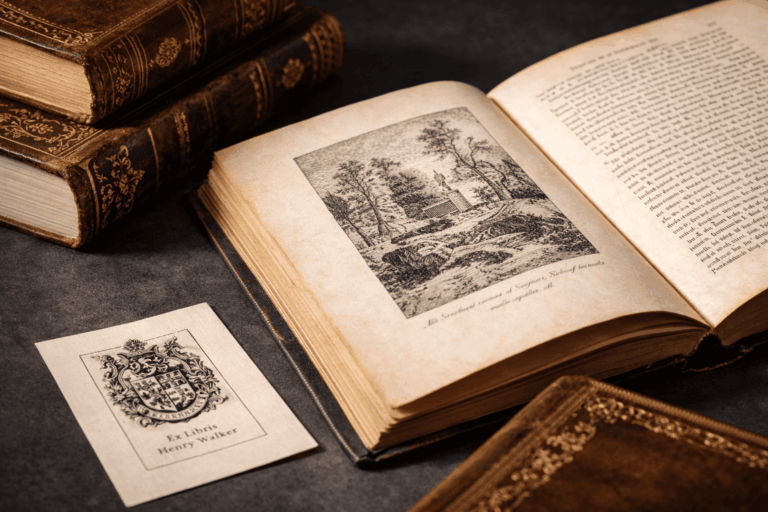
The term antiquarian is different again. It refers primarily to age and historical character. An antiquarian book is generally understood to be an older book, often from an earlier printing era, valued as a historical and material object. While there is no absolutely universal cutoff, antiquarian books are commonly associated with the hand-press period or with books from the eighteenth and nineteenth centuries and earlier. The word suggests not merely age, but a connection to the physical and bibliographical traditions of earlier bookmaking: laid paper, early bindings, old typography, engraved plates, and historical provenance.
Importantly, not every antiquarian book is rare, and not every rare book is antiquarian. A seventeenth-century sermon may be antiquarian without being especially scarce or valuable. Conversely, a first edition of a twentieth-century literary landmark may be rare and highly collectible without being antiquarian at all. Antiquarian describes historical class and material period; rare describes scarcity in relation to demand. These are overlapping, but distinct, concepts.
Vintage occupies yet another category. In the book world, vintage usually refers to books that are old enough to possess period character, but not old enough to be considered antiquarian in the stricter sense. The term often applies to books from the early or mid-twentieth century, especially those appreciated for design, dust jackets, illustration, typography, or cultural atmosphere. Vintage books may appeal to collectors because they embody the aesthetics of a particular era. They often occupy the space between the merely second-hand and the formally antiquarian.
Yet vintage should not be mistaken for automatic value. A vintage paperback or decorative hardback may be charming and desirable, but charm alone does not create serious collectibility. Some vintage books become highly collectible because of author, edition, condition, or cultural significance. Others remain attractive period objects with modest market value. As with all categories in collecting, context is decisive.
In practice, a single book may fit more than one of these terms. A book can be collectible and rare. It can be antiquarian and collectible. It can be vintage and rare. What matters is using the terms precisely enough to understand what exactly is being claimed. Is the book being valued for age, for scarcity, for period style, or for market demand? Those are not identical questions.
For collectors, the practical lesson is simple. Do not buy labels; buy books with understood characteristics. Ask whether the item is scarce, whether it belongs to an older historical period, whether it reflects a distinctive twentieth-century era, and whether there is genuine collector demand behind it. A seller’s language should be tested against the actual object.
Precision in terminology leads to precision in judgment. And in the rare book world, judgment is far more valuable than enthusiasm alone.