Book Categories:

Wait, don't go!
We have a special offer just for you!
Get 20% off your next purchase.

Book Categories:


We have a special offer just for you!
Get 20% off your next purchase.


In book collecting, value is never determined by text alone. Two copies of the same work may contain the same words and yet differ radically in desirability, character, and market importance. The reason lies in the physical details that transform a book from a reading object into a collectible artifact. Among the most admired of these details are illustrations, bindings, and bookplates. To an inexperienced buyer, they may seem secondary or merely decorative. To the serious collector, however, they often reveal the individuality of a copy, the standards of its production, and the cultural world through which it has passed.
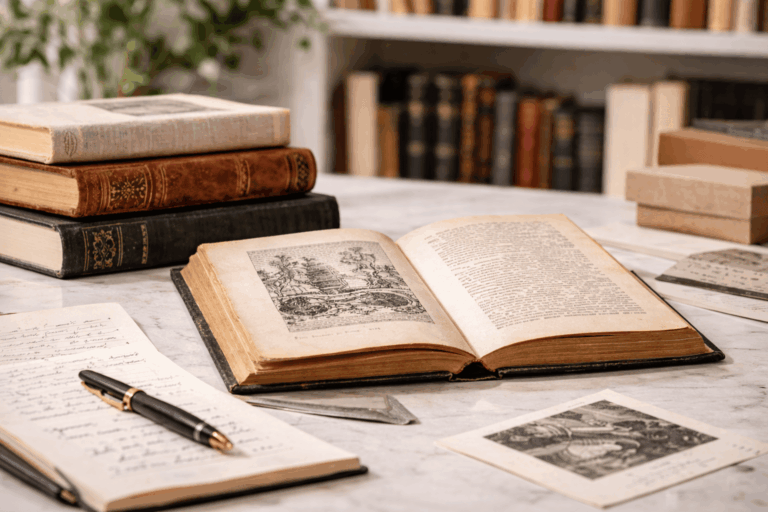
Illustrated editions hold a special place in many collections because they unite literature with visual interpretation. Illustration changes the reading experience by giving material form to scenes, symbols, and atmospheres that would otherwise remain entirely verbal. In some books, the illustrations are incidental. In others, they are central to the identity of the edition itself. Certain works are collected precisely because they were interpreted by a major illustrator, engraver, or designer whose contribution became inseparable from the text. In such cases, the illustrations do not merely accompany the book; they define it.
Collectors value illustrated editions for several reasons. First, illustrations often distinguish one edition from another in a substantial way. A text printed plainly for utility may be bibliographically important, but an illustrated issue can possess a different kind of appeal—one rooted in craftsmanship, visual imagination, and completeness of conception. Second, illustrated books frequently preserve traces of printing history: engraving techniques, plate impressions, hand-coloring, lithography, and typographic design all reveal the production values of their time. Third, well-executed illustrations often create an edition that is pleasurable not only to read, but to study as an object. Such books reward repeated attention because they work simultaneously on literary and visual levels.
Yet illustrated editions also require careful evaluation. A desirable illustrated copy must be complete. Missing plates, damaged images, trimmed margins, or later substitutions materially weaken the integrity of the book. In some fields, the presence of all illustrations is so essential that an incomplete copy loses much of its collector value, even when the text itself remains intact. This is why serious buyers examine collation closely. A book described as illustrated must be judged not only by the beauty of its surviving images, but by whether those images remain fully and correctly present.
Fine bindings represent another category of detail that collectors prize. A binding is not simply a container for a text. It is the outer expression of the book as a crafted object. Fine bindings can increase desirability because they add artistry, individuality, and material richness to the volume. Leather tooling, gilt decoration, raised bands, inlays, doublures, marbled endpapers, and carefully executed structural work all contribute to the impression of distinction. In some books, the binding is the primary reason for collector interest; in others, it deepens the appeal of a text that is already important in literary or historical terms.
Still, binding must be judged with precision rather than sentiment. Not every elaborate cover is a fine binding in the true sense. Some later decorative bindings are attractive but historically disconnected from the text they enclose. A rebound copy may remain beautiful while losing part of its original bibliographic character. For some collectors, an elegant later binding enhances value; for others, originality carries greater importance. The key question is not whether a binding is luxurious, but whether it is appropriate, well executed, honestly described, and meaningful in relation to the copy. Fine collecting depends on understanding that beauty and integrity are related, but not identical, qualities.
Bookplates introduce a more intimate dimension. A bookplate is often a small thing: a printed or engraved ownership label affixed inside a book, usually on the front pastedown. Yet for collectors, it can be remarkably significant. Bookplates reveal that books belonged to real people, moved through actual libraries, and participated in the habits of ownership and inheritance. They transform anonymous copies into historical witnesses. A volume from a distinguished private library, a scholarly collection, or a notable estate often carries greater individuality because of such marks.
Collectors appreciate bookplates not only for provenance, but also for their artistic and cultural value. Many are finely engraved, heraldic, symbolic, or typographically refined. They reflect the identity, taste, and ambitions of their owners. In this sense, a bookplate is both evidence and ornament. It may record a family, an institution, a profession, or an intellectual circle. It may also contribute aesthetically to the opening impression of the book. Yet, as with all provenance, not every bookplate adds equal value. Its significance depends on whose it is, how well it is documented, and how it interacts with the rest of the copy’s history.
What unites illustrated editions, fine bindings, and bookplates is that each draws attention to the physical life of books. They remind the collector that a book is not a neutral vessel for text, but a made object shaped by artists, binders, printers, designers, owners, and readers. These details are loved not because they are superficial embellishments, but because they preserve traces of production, taste, and transmission across time.
The strongest collections often grow from precisely this awareness. A collector begins to see that value lies not only in authors and titles, but in editions with distinguished illustrations, bindings that express craftsmanship, and ownership marks that reveal a copy’s passage through history. Such details do more than decorate a shelf. They give books individuality. And in collecting, individuality is one of the rarest and most enduring forms of value.