Book Categories:
Wait, don't go!
We have a special offer just for you!
Get 20% off your next purchase.
Book Categories:


We have a special offer just for you!
Get 20% off your next purchase.


The value of a rare book is never determined by age alone. This is one of the first truths every collector must understand. Many old books are modest in value, while certain modern books can command exceptional prices. A rare book becomes valuable through a combination of factors: scarcity, condition, edition, historical importance, provenance, binding, and market demand. To judge a book properly, one must consider how these elements interact rather than relying on any single feature.
Scarcity is an obvious starting point, but even scarcity is more complex than it appears. A book may have been printed in small numbers, yet attract little interest from collectors. In that case, rarity exists, but high value may not. Conversely, a book by a major author may survive in relatively larger numbers and still be highly valuable because demand is strong. True market value emerges where limited supply meets sustained desirability. This is why books by important literary, scientific, philosophical, or historical figures often remain especially collectible.
Edition is another critical factor. In many cases, collectors place the greatest value on the first edition, especially the first printing of a major work. A first edition stands closest to the historical moment of publication and often carries special authority. However, the term must be used carefully. Not every so-called first edition has the same significance, and publishers’ practices vary across time and place. Bibliographic accuracy matters. Some later editions may also be valuable if they contain substantial revisions, important illustrations, or distinctive physical features absent from the first.
Condition has an immense influence on value, sometimes more than beginners expect. Two copies of the same edition can differ dramatically in price because of their condition. Collectors generally prefer copies that are complete, clean, and structurally sound. Missing pages, heavy staining, loose bindings, repairs, cropped margins, or major wear reduce desirability. In modern collectible books, the presence and condition of the original dust jacket can be especially important. In older books, a fine survival in original boards or an attractive period binding may significantly increase value. Condition is not merely cosmetic; it affects both scholarly usefulness and collector appeal.
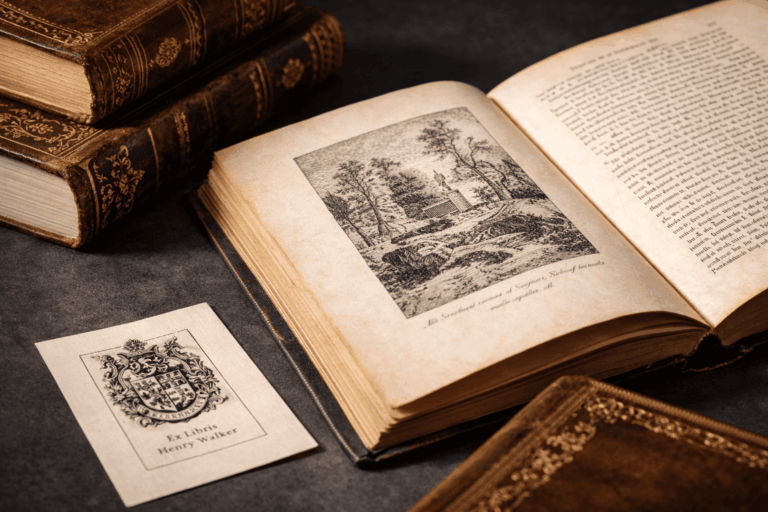
Provenance can also elevate a book from interesting to exceptional. Provenance refers to the history of ownership and association. A book that belonged to a notable writer, scholar, collector, institution, or historical figure may acquire additional importance beyond its text. Bookplates, inscriptions, annotations, auction records, and library marks can all contribute to provenance, although not all marks are equally desirable. In some cases, an author’s inscription or a meaningful association copy may be worth far more than an unsigned counterpart. Provenance adds narrative, and in collecting, narrative has real value.
Binding is another element that should not be underestimated. A book is both a text and a physical object. Fine bindings, decorative covers, signed bindings, and well-preserved original publisher’s bindings can increase value substantially. This is especially true in collecting fields where craftsmanship matters as much as content. In antiquarian books, an elegant contemporary binding may be desirable, while in twentieth-century collecting, originality often carries greater weight. A rebound copy may still be valuable, but rebinding can remove evidence of period character and reduce collector interest if done poorly or unsympathetically.
Historical and cultural importance remains central. Some books matter because they changed literature, science, politics, religion, or art. Others matter because they reflect a turning point in printing history or intellectual history. A first edition of a landmark text is valuable not only because it is scarce, but because it represents a decisive cultural event. Collectors, institutions, and scholars all compete for such material, and that competition reinforces value over time.
At the same time, market demand must never be ignored. Value is shaped by collectors’ interests, which can shift across decades. Certain authors, genres, or visual traditions rise in popularity, while others cool. A book is not valuable in the abstract; it is valuable within a living market. This is why auction results, dealer catalogs, and specialist expertise remain essential reference points. Sentimental importance may matter to an individual buyer, but market value depends on broader recognition.
For collectors, the practical lesson is clear. When evaluating a rare book, ask several questions at once. Is it genuinely scarce? Is the edition important? What is its condition? Does it retain original features? Is the provenance notable? Does the book have recognized cultural significance? And above all, is there real demand for it? No single answer is sufficient on its own.
A valuable rare book is usually one in which bibliographic significance, physical integrity, and collector desire converge. Understanding that convergence is the foundation of intelligent collecting. It allows buyers to move beyond superficial impressions and see rare books for what they truly are: historical objects whose value lies in the union of text, material form, and cultural memory.