Book Categories:
Wait, don't go!
We have a special offer just for you!
Get 20% off your next purchase.

Book Categories:


We have a special offer just for you!
Get 20% off your next purchase.


Buying an antiquarian book can be one of the most rewarding forms of collecting. Such books offer more than text: they preserve the material evidence of another age, including paper, typography, binding, and traces of ownership across time. Yet precisely because they are valued as historical objects, antiquarian books must be approached with care. A buyer should never assume that age alone guarantees authenticity. Misdescribed editions, later facsimiles, composite copies, restored examples, and modern reproductions all exist in the market. To identify an authentic antiquarian book before buying, one must learn to read the object critically.
The first point of examination is bibliographic identity. An authentic antiquarian book must correspond to a known edition, issue, or printing. This begins with the title page, which usually provides the author, title, publisher or printer, place of publication, and date. These elements should be examined carefully, not superficially. Spelling, typography, line breaks, and imprint wording can all matter. In older books, title pages were not always standardized, and bibliographic details may appear in forms unfamiliar to modern readers. That is why comparison with reputable bibliographies, library records, or specialist dealer descriptions is essential when uncertainty arises.
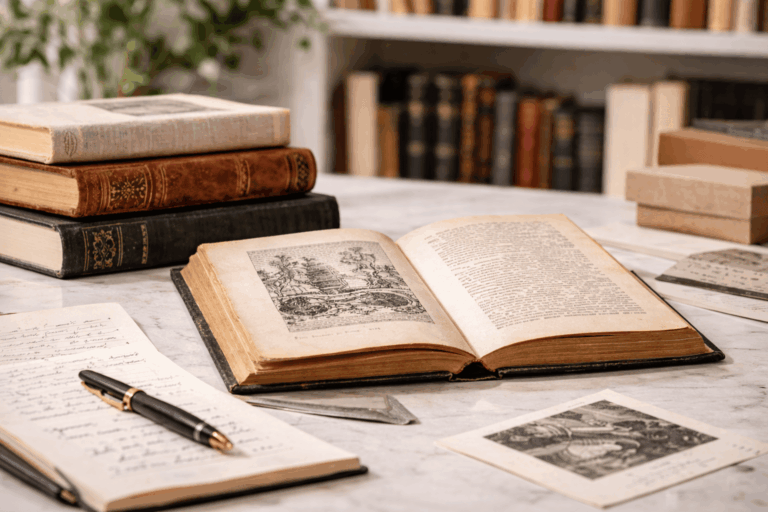
Next comes collation, a subject often neglected by beginners. A book is not fully authentic if it is incomplete. Missing leaves, plates, maps, or advertisements may seriously affect both scholarly and commercial value. In older books, gatherings were assembled according to a signing system, and these signatures, along with pagination and catchwords, help determine whether the text is complete. Many antiquarian books appear sound externally while lacking crucial internal material. An intelligent buyer therefore looks beyond the binding and examines whether all required parts are present.
The physical construction of the book also provides important clues. Antiquarian books reflect the materials and methods of their time. Paper texture, type impression, sewing structure, and binding style should broadly correspond to the stated period. Hand-pressed paper, laid lines, chain lines, watermarks, deckled edges, and letterpress impressions may all be relevant in earlier works. Conversely, a copy claiming great age but showing obviously modern paper or mechanical reproduction should raise suspicion. This does not mean every old book must remain in original condition; many were rebound or repaired. But the physical evidence should make historical sense.
Binding deserves especially careful attention. An authentic text block may sit inside a later binding, and that is not inherently problematic. In fact, many valuable antiquarian books survive in rebinding from a later century. The issue is not whether the binding is original in every case, but whether the seller describes it honestly and whether the binding is appropriate to the book. Problems arise when later materials are misrepresented as contemporary, or when decorative rebinding is used to conceal loss, repair, or incompleteness. A fine binding can enhance value, but it should never distract from examination of the underlying copy.
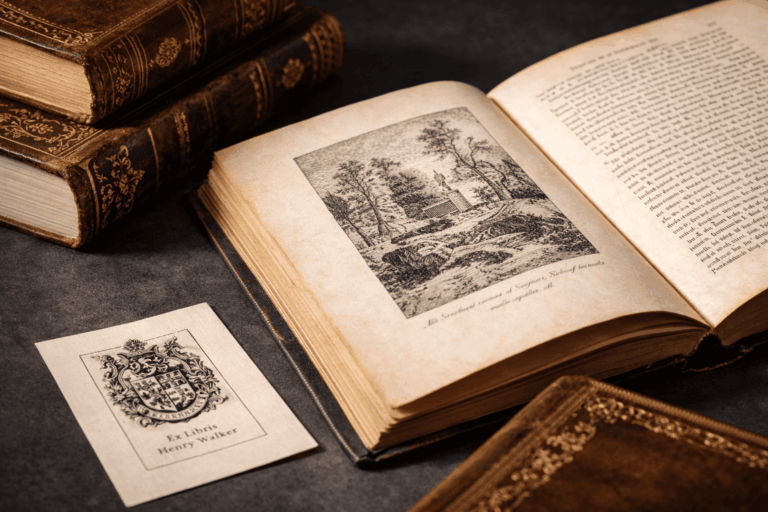
Provenance can help confirm authenticity, though it must be interpreted critically. Bookplates, ownership inscriptions, shelf marks, old auction labels, and institutional stamps may establish a credible history of ownership. In some cases, provenance materially strengthens a copy by linking it to a notable library or collector. Yet provenance should not be romanticized. An old inscription does not automatically prove authenticity of edition, completeness, or originality of parts. It is evidence to be integrated with the broader examination, not a substitute for it.
Buyers should also watch for restoration and facsimile work. Restoration is common in antiquarian books and is not always a defect if properly disclosed. Still, it must be understood. Replaced title pages, washed paper, repaired margins, remargined leaves, supplied maps, or facsimile plates can materially alter value. The problem is not restoration itself, but undisclosed or excessive restoration that changes the integrity of the copy. A book may be genuine yet compromised. Serious collecting requires learning that authenticity and condition are related, but not identical, questions.
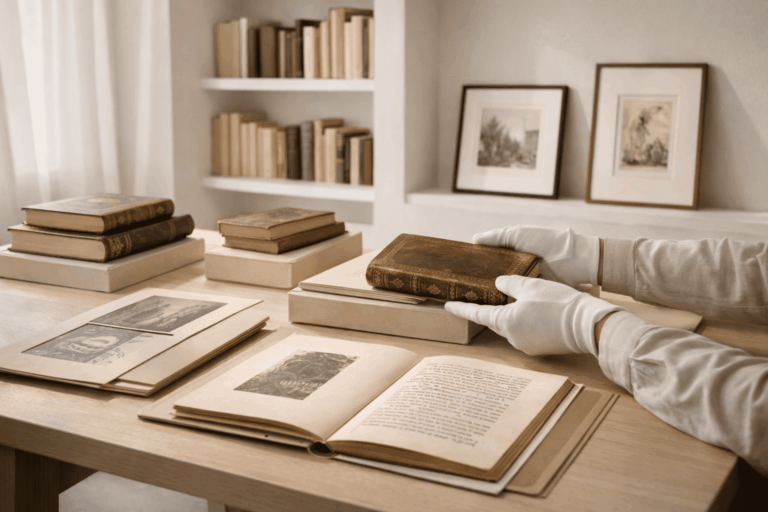
Perhaps the most practical safeguard is the quality of the seller. Reputable antiquarian booksellers describe books precisely, disclose faults, and answer technical questions without evasion. A vague description is often more dangerous than a visible defect. Buyers should ask for detailed photographs of the title page, colophon, binding, spine, edges, and any damaged areas. It is also reasonable to ask whether the book is complete, whether it has been restored, and whether the binding is original or later. A competent dealer will understand why those questions matter.
Ultimately, identifying an authentic antiquarian book means learning to see the book as evidence. Its date, materials, typography, collation, binding, and ownership marks all contribute to the judgment. No single sign is sufficient on its own. Authenticity emerges when the bibliographic record and the physical object agree with one another in a coherent way.
For that reason, the best protection is disciplined attention. Do not buy an antiquarian book merely because it looks old, elegant, or impressive. Buy it because its physical reality has been examined, its description has been tested, and its historical identity makes sense. That is the difference between acquiring an old object and acquiring a genuine antiquarian book of lasting value.